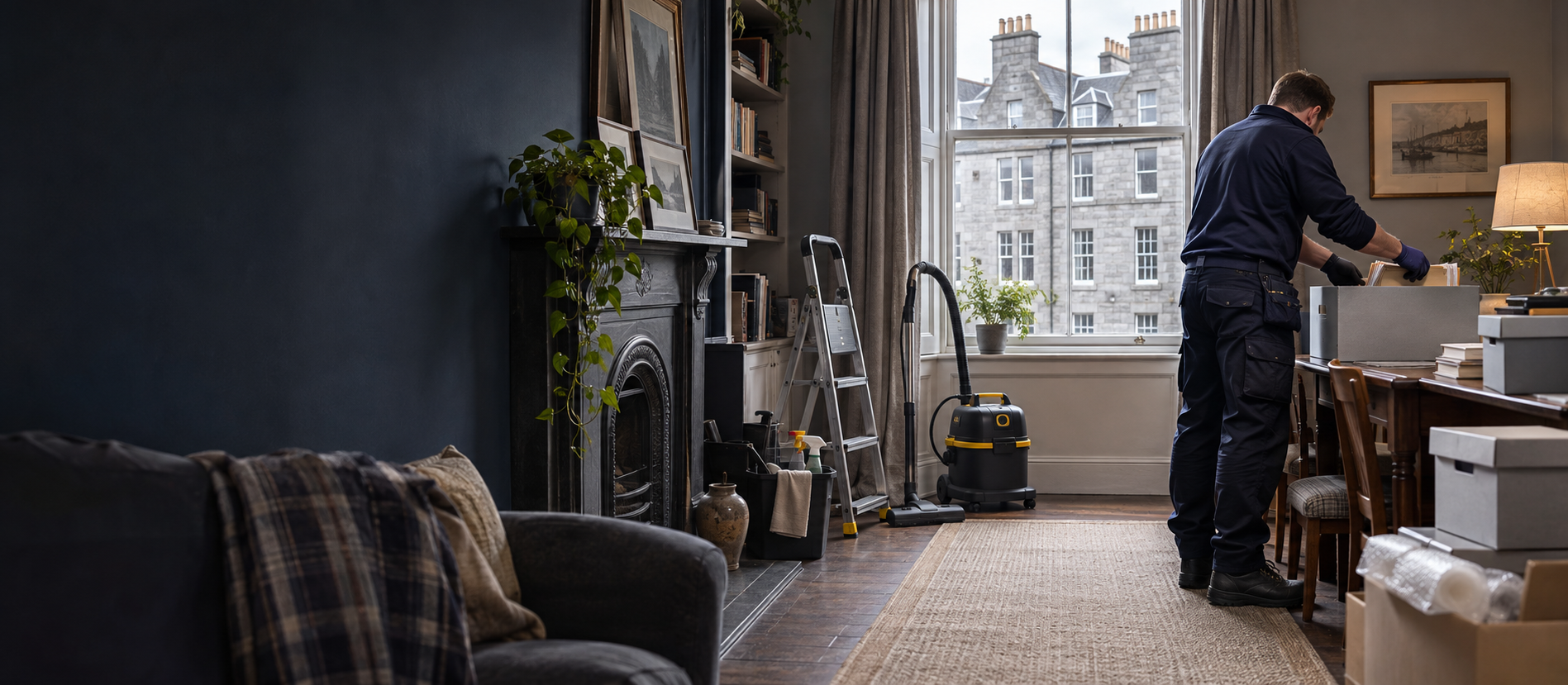
Hoarding and heavily cluttered property cleaning in Aberdeen and Aberdeenshire
A crowded home is rarely a simple collection of things to be taken away. It may contain documents that cannot be replaced, belongings with personal meaning, usable furniture, damaged materials and areas that have become difficult to reach safely. Nova Clean Aberdeen helps households, relatives, landlords and property managers plan careful cleaning and clearance when the amount of clutter or the condition of a property has gone beyond an ordinary tidy-up. We begin with a conversation about who can authorise decisions, what must be kept, the condition of each room and what a successful handover would look like. A practical plan can then separate sorting, removal, cleaning and any additional specialist work.
Our enquiries come from Aberdeen neighbourhoods such as Rosemount, Ferryhill, Torry, Tillydrone, Bridge of Don, Dyce and Cove Bay, as well as Westhill, Portlethen, Stonehaven, Inverurie and other communities across Aberdeenshire. A granite tenement with a shared stair presents different access and carrying conditions from a detached home with a drive or a rural property with outbuildings. We ask about the route into the property, parking, lifts or stairs, the number of affected rooms and whether essential services are working before suggesting the next step. The scope, availability and price are confirmed for each address.
Start with consent, priorities and a clear boundary for every decision
People use the term hoarding cleaning for very different situations. One person may want help restoring a workable kitchen while retaining most possessions. Another may be coordinating an empty property after a tenancy, a bereavement or a prolonged absence. The legal right to instruct work and dispose of belongings matters, especially when family members, an executor, a landlord, a housing provider or a managing agent are involved. We establish the decision maker and any restrictions before a team begins sorting. If those responsibilities are unclear, it is better to resolve them before arranging a clearance date.
We ask you to identify documents, keys, photographs, medication, mobility equipment, valuables and any other items that must not be removed. A keep area or labelled containers can give the team a practical way to protect them. The person who has authority should also agree how uncertain items will be set aside for review, how progress decisions will be made and whether anyone needs to be present. These details take time at the beginning, but they reduce the risk of an irreversible mistake and help everyone understand the limits of the work.
Assess the property before choosing equipment or booking a large team
Photographs and a short description can help us understand the first enquiry, but they do not reveal everything behind stacks or inside closed rooms. We consider the volume and type of material, the accessible floor area, signs of leaks, damaged electrics, unstable furniture, sharp objects, pest activity, food waste and any odour. We also need to know whether the water supply, lighting and heating are available. If access is unsafe or the condition is uncertain, an assessment may be necessary before a firm quotation. Nobody should assume that a property is safe merely because the entrance appears clear.
For a flat in central Aberdeen, a shared entrance and narrow stair can determine how materials are packed and carried, how long removal takes and how common areas are protected. In a house near the coast, damp conditions may affect stored paper, timber and soft furnishings. A property in rural Aberdeenshire may have more space for vehicles yet require a longer journey and a different approach to loading. We factor these practical details into the proposal rather than pricing only by the number of bedrooms. A useful quotation states what will be sorted, what will be removed, which rooms will be cleaned and what remains subject to inspection.
Work in stages so useful belongings are not lost in a rushed clearance
Where the occupant remains involved, a staged approach is often more manageable than emptying the whole home at once. The first stage may establish a safe route to the door, bathroom and kitchen. The next may focus on one room and a small number of decisions at a time. Items can be separated into keep, review and agreed removal streams, with uncertain possessions left untouched until the authorised person decides. This method also allows essential routines to continue while the work progresses. The pace should suit the circumstances of the household and the agreed deadline.
Some projects require a complete clearance before a sale, repair or tenancy handover. Even then, the categories of items and decision process should be agreed in advance. Papers can be easily overlooked among magazines or packaging. Small valuables can be concealed in drawers or containers. A team cannot guarantee that every hidden item will be discovered, so we discuss realistic checks and the level of sorting included. If confidential records are present, they should be identified and handled under a specific instruction rather than mixed into ordinary waste. Photographs of stages may help the client track progress where appropriate and agreed.
Separate general clutter, waste and materials needing specialist handling
Not everything in a heavily cluttered home belongs in the same disposal stream. Reusable belongings, ordinary household rubbish, bulky furniture, electrical equipment, paint, chemicals, sharps and potentially contaminated items may each need a different route. We discuss the likely categories before work starts and confirm what disposal arrangements are included in the price. If an item needs specialist collection or a separate contractor, that should be made explicit. The same applies to fixtures, carpets and appliances: removal can require extra labour, safe disconnection or permission from the property owner.
We do not advise opening unknown containers, handling needles or moving unstable piles without an assessment. Where food residues, animal fouling or biological contamination are present, cleaning and waste handling may need additional controls and equipment. The presence of mould or strong odours can also change the plan, but an odour alone does not identify its cause. We explain the limits of the proposed service and may recommend a separate inspection or repair before final cleaning. This prevents a routine clearance from being presented as a complete solution to an unresolved building or safety problem.
Clean the exposed surfaces after removal with methods suited to the material
When possessions are moved, surfaces that have been covered for years may show dust, staining, residue or damage. We first remove loose debris and dust with suitable equipment, then inspect accessible floors, skirting boards, shelves, cupboards, kitchens and bathrooms. Products and methods depend on the surface: a sealed worktop, timber floor, painted wall and delicate stone do not tolerate the same treatment. Dry dusting may spread fine material, while excessive water can worsen a porous or damaged surface. A careful sequence works from higher accessible areas down to floors, with cleaning repeated where accumulated residue warrants it.
A clean appearance does not prove that a material has been disinfected or restored. If disinfection is requested, we discuss the reason, the affected surfaces, the product and the conditions needed for its use. Porous items may be difficult to treat thoroughly, and persistent staining or damage may require replacement or repair rather than more cleaning. We distinguish cleaning, odour treatment, pest management and building works in the quotation. In some homes, the final task is a usable and hygienic room; in others, it is a property ready for contractors to assess. The agreed outcome guides the work.
Protect occupants, neighbours and shared areas during the operation
Discretion is particularly important when a property is occupied or has close neighbours. We discuss arrival times, access arrangements and who may receive updates. In a tenement or managed block, the route through halls and stairs should be considered before moving large objects. Floors and corners may need protection, and materials should not obstruct exits or common areas. Vehicle loading and any temporary storage must be planned around the actual location. A clear contact person can help resolve unexpected decisions without leaving the team waiting or prompting it to make assumptions about belongings.
When the occupant wishes to remain in the home, they should understand which rooms will be unavailable during each stage and how essential access will be maintained. Children, pets and other residents may need to stay away from active work areas. If there are concerns about structural stability, electrics, water penetration or hazardous materials, the relevant condition should be assessed by the appropriate specialist before cleaning proceeds in that area. We can adapt the order of rooms, but we should not promise an unrestricted working environment when the property itself does not allow one.
Plan a realistic handover for landlords, families and property managers
A landlord may need the property cleared for inspection, a family may want particular possessions retained, and a managing agent may need evidence of which rooms were treated. These are different outcomes. We ask for an inventory, written instructions and a point of contact who can answer questions during the work. The proposal can identify priority rooms, the degree of sorting included, waste volumes that may affect the price and whether a return visit is anticipated. Photographs supplied before an assessment can be useful, but a fixed price based on incomplete information can create misunderstandings if hidden conditions are later found.
At handover, it helps to compare the completed work against the agreed scope rather than an undefined standard of perfection. We can identify areas cleaned, items retained for collection, materials that could not be treated safely and further work that may be required. Where carpets, walls or fitted units are irreversibly damaged, cleaning may reveal the issue without resolving it. Where an underlying leak or pest entry point remains, recurrence is possible until that cause is addressed. A clear account of these limits supports the next decision by the owner, family or housing team.
What determines the cost and length of a hoarding clean
The price depends on the labour needed for sorting, the volume and type of items, safe access, transport, disposal routes and the level of cleaning after removal. Two homes with the same floor area can require very different amounts of work. A room full of boxed possessions with clear access is unlike a room where loose material conceals floors, electrical points or water damage. Stairs, long carrying distances and the need to protect shared spaces can add time. The number of decisions reserved for the client also matters: careful item-by-item review is more labour intensive than removal of categories that have already been agreed.
We prefer a written proposal that distinguishes a first visit or assessment, sorting and packing, agreed removal, deep cleaning and optional tasks. If a quote has a limit on volume or working hours, that limit should be understandable before work starts. An unforeseen hazard or concealed damage may mean pausing the affected area and agreeing a revised scope instead of continuing without direction. A small staged project can sometimes be easier to budget than a complete clearance, particularly when the occupant wants to retain much of the household. We do not publish a single price per room because it would hide the factors that determine the actual work.
How to request a useful quotation for an Aberdeen property
Tell us the postcode, type of property, number of rooms, approximate level of clutter, whether anyone lives there and who can authorise sorting and disposal. Describe access, stairs, parking, working utilities, urgent deadlines and any known hazards. Photos are helpful when they can be taken safely and respectfully; do not enter an unsafe room just to obtain them. List items to retain, rooms that must remain usable and the result you need after clearance. If the property is managed, mention building rules and the hours available for work. We can then say whether a visit is needed and what a written scope should cover.
For related work, see our after death cleaning service when a bereavement has affected the property, or discuss pigeon fouling removal if balconies or loft areas are involved. These are distinct assessments and are not automatically included in hoarding cleaning. Call 0845 52 805 20, email