House clearance and decluttering in Aberdeen and Aberdeenshire
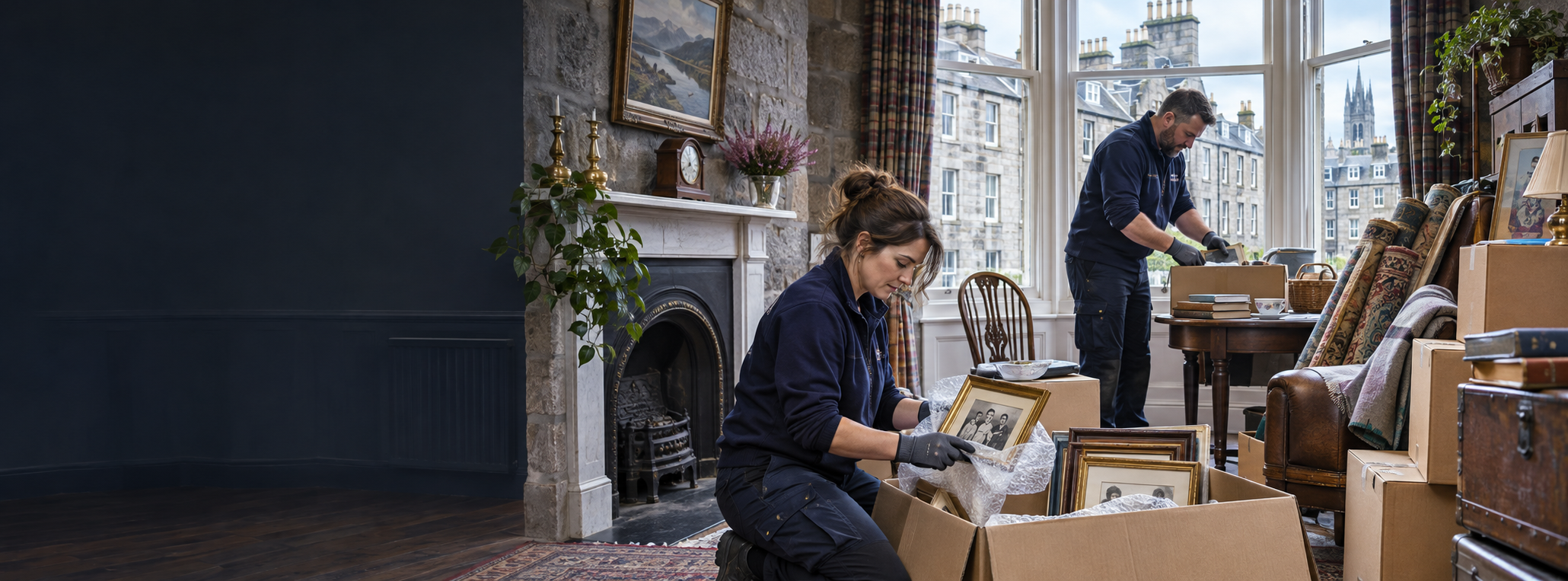
House clearance and careful decluttering across Aberdeen
Clearing a house after a move, a bereavement, a long vacancy or a change in tenancy involves decisions that deserve more care than loading everything into a vehicle. Nova Clean Aberdeen discusses house clearance and decluttering with private owners, families, executors, landlords and property managers across Aberdeen and Aberdeenshire. We establish who can authorise removal, what must be kept, what needs separate handling and whether cleaning is required after the property has been emptied. The circumstances determine the sequence. A straightforward empty flat in Ferryhill differs from a rural home near Banchory with outbuildings, or a heavily accumulated property in which documents and valuables may be hidden among everyday belongings.
Start by giving us the postcode, type of property, number of floors and rooms, approximate volume of contents, access arrangements and your required handover date. Tell us which areas are excluded, whether a family member or agent will be present and whether the belongings have already been sorted. Photographs of each room can help us assess scope when taken with the owner's permission. A visit is appropriate when volume, condition or items needing special handling are uncertain. We explain which tasks a quotation includes rather than treating clearance, deep cleaning, repairs and storage as one interchangeable service.
Agreeing authority, ownership and a written sorting plan
Only a person with the appropriate authority should instruct a team to remove possessions. That matters particularly following a death, a disputed tenancy or a property sale. Before work begins, the customer identifies who owns the contents, who may approve disposal and how decisions about uncertain items will be made. We ask for an accessible contact during the work if discoveries require a decision. We do not assume that an empty looking cupboard contains unwanted items, or that papers with little monetary value have no importance to a family.
It helps to mark three groups before a clearance: items to keep, items whose destination is already agreed and items requiring a decision. Keep lists can specify rooms or individual objects; photographs can record their position. If the customer cannot attend, an agreed written instruction is more reliable than informal assumptions made by different people. Keys, identity documents, financial papers, medicines, photographs, small valuables and digital storage should be identified for secure handling. If items are found during the job that were not in the original plan, work on them can pause while the customer decides.
Staged decluttering when rooms are difficult to enter
A heavily cluttered property may need an access path before any systematic sorting can take place. We assess whether floors, stairs, exits and utilities are safe to use and whether sharp objects, pests, spoiled food or unstable stacks are present. The initial stage may focus on safe movement and segregation of obvious waste, while preserving any zone that the customer has asked us not to disturb. A later stage can examine rooms more thoroughly. This gives family members or support workers time to identify records, medication and meaningful possessions without putting them under pressure to make every decision at the doorway.
Decluttering may involve someone who has struggled to manage belongings for years. We use factual language about the condition of the property and agree practical boundaries. We do not claim that a single clearance resolves the cause of accumulation or prescribe personal support. If an occupant remains in the home, we ask who will coordinate decisions and how the work can avoid removing essential daily items. Specialist cleaning of heavy contamination has its own assessment and protective requirements, and may be quoted separately from the removal of contents.
From upper floors to garages and exterior storage
Many Aberdeen tenements have narrow stairs, shared entrances and limited space for loading. A survey should consider lift access, parking and the route from each room to the vehicle. We protect communal areas as agreed with the building manager and discuss timing that limits disruption to neighbours. In suburban and rural properties, garages, sheds, lofts and garden stores can account for more volume than the living rooms. These areas may contain paint, fuel, batteries, old electrical equipment, sharp tools or materials suspected of containing asbestos that cannot be treated as ordinary mixed household waste.
Large furniture may need dismantling where safe and authorised. We ask whether any fixture belongs to the building, whether the contents of fitted cupboards are to be removed, and whether flooring or white goods are within scope. Heavy appliances may require isolation and safe disconnection by a competent person before removal. A quotation should set out the rooms, outbuildings, estimated volume and number of collection stages, together with assumptions about unobstructed access. Changes discovered on the day should be discussed before additional work is undertaken.
Waste, reuse and items needing a separate route
Responsible clearance means sorting materials for the appropriate destination where this is practical. Reusable items are only candidates for donation or resale if their condition and the receiving organisation's requirements allow it. We cannot guarantee a charity will accept particular furniture, and the owner should not rely on an assumed resale value to offset a clearance quote. Electrical items, batteries, mattresses, liquids, chemicals and potentially hazardous materials need attention to their specific disposal route. We discuss these separately so a customer knows what is included.
If a property contains needles, bodily fluids, extensive mould, pest contamination or large quantities of spoiled food, tell us before the visit. The team, equipment and protective measures may differ from an ordinary clearance. We do not silently mix hazardous waste with general items or promise to remove unidentified substances. Documentation of waste handling can be agreed where the customer or managing agent needs it. Clearance also has limits: structural demolition, asbestos removal, pest treatment and specialist document destruction require separate arrangements.
Cleaning after the last item has left the building
Once rooms are empty, hidden dust, staining and damage become easier to see. The handover clean can cover accessible floors, skirting boards, surfaces, inside empty cupboards, sanitary areas and kitchen fixtures as specified in the written scope. A property that has stood closed may need ventilation and a more detailed assessment before a final cleaning plan is fixed. We will flag areas where plaster, paint, flooring or plumbing need repair rather than presenting a wipe-down as a substitute for building work.
End of tenancy standards often depend on an inventory and the original condition of the property. We ask the landlord or agent for those documents if a formal handover is the aim. A probate sale, meanwhile, may prioritise making every room accessible and clearly documented for viewings. For an occupied home, the aim may simply be to reduce excess items and restore usable space. Each outcome calls for a different sequence and a different level of finishing, so the cleaning component should be described separately from the clearance component.
Special circumstances after a death or property incident
Following a bereavement, relatives may need a staged timetable and a single point of contact, especially when they live outside Aberdeenshire. We can discuss a room-by-room plan that leaves documents, photographs and personal items for review. If an unattended death has affected the premises, biological cleaning and clearance require a more specific assessment than an ordinary estate clearance. Likewise, after fire or flood, damaged building materials and contents may be subject to insurer instructions. Photograph and document affected items before disposal where the insurer requests it, and agree who has authority to release them.
We do not offer legal advice about estates, ownership or tenancy rights. Customers should resolve those questions with the relevant representative before instructing removal. Our practical role is to carry out an agreed scope, keep clearly identified belongings aside and report any uncertainty that could change the plan. Discretion matters when neighbours, trades and family members are all involved. Access details and project information are shared with the people needed to arrange the work.
Decide what stays before filling removal containers
A clearance should start with categories agreed by the person authorised to instruct the work. Documents, photographs, jewellery, medication, keys and digital devices may be easy to overlook in a crowded room. We discuss a dedicated area for items to retain and a decision process for uncertain objects. The team should not guess whether a box is valuable or whether a furniture item belongs to a tenant, landlord or relative. Where more than one person has a claim or interest, those decisions should be resolved before disposal begins.
Photographs of each room and a simple inventory can help a family or managing agent make decisions without entering every difficult space. A staged approach may first create a safe route, then sort accessible items, then address rooms that were blocked. The cost and time depend on volume, access, material condition and the level of sorting required. A one-price promise from an exterior photograph alone can miss the effort of protecting possessions.
Consider the route from the room to the vehicle
An upper-floor flat in Aberdeen may have a narrow staircase, shared entrance or limited parking. Large furniture may not pass through a doorway without dismantling, which should be agreed separately. We ask whether a lift is available, whether it can be protected and how neighbours will retain access. Heavy items and unsafe stacks require a planned method rather than rushed lifting. The route can have a greater effect on the programme than the floor area of the property itself.
Storage rooms, lofts and garages need their own inspection. A loft may have no safe floor beyond the joists; a garage may contain fuel, paint, batteries or sharp tools. These should be identified before ordinary waste is loaded. We do not assume that every material follows the same disposal route. A quotation should explain any limits and the arrangements for items that need a specialist collection.
Leave an understandable condition at handover
Removing contents does not automatically make a property clean. Dust behind furniture, marks on floors and deposits in cupboards may need a separate house and flat deep clean. We can sequence that work after sorting and removal so the surfaces are accessible. If a property is damp or has contamination after a death or leak, a different specialist plan may be needed before ordinary deep cleaning. The owner should know which state the quotation is intended to achieve.
At the end, the authorised contact can check the retained items, the areas cleared and any object left because it required a decision or special handling. A brief record helps resolve questions later. We avoid making unsupported claims that all removed contents were reused or recycled; the actual route depends on condition and available arrangements. The goal is a respectful, traceable clearance with a clear boundary between sorting, removal, cleaning and repair.
Keep a clear decision trail for uncertain items
If an object has no obvious owner or its value is unclear, place it in a separately labelled group for the authorised contact rather than discarding it. That small pause can prevent a distressing mistake. At handover, the client can review retained items and note any space still inaccessible. This is especially useful when relatives or managing agents cannot attend every stage.
What a useful Aberdeen clearance quotation should state
The written proposal should identify the site, rooms, access conditions, approximate contents, sorting assumptions, removal and disposal tasks, any cleaning stage and the exclusions. It should also address whether heavy furniture, appliances, loft contents and exterior stores are included, and whether photographs or a completion record are requested. A firm cost can only follow a reasonable assessment of volume and condition. We confirm availability for Aberdeen, Westhill, Inverurie, Ellon, Stonehaven, Portlethen, Peterhead and other Aberdeenshire locations individually.
For an initial discussion, call 0845 52 805 20 or email